Roelof + Alto + Landverhuizers + Shadowbox-1 + Shadowbox-2 | Warnerius + citaten | Aäron | Zwolse Courant
Philip Jacob 1819 | Berend 1829 | Jacoba letter | Jacoba interview | Rock | The Shirley Book | Book "Netherlanders in America"
Roelof
+ Alto + Landverhuizers + Shadowbox-1 + Shadowbox-2 | Warnerius + citaten
| Aäron
| Zwolse Courant
Philip Jacob 1819 | Berend 1829 | Jacoba letter | Jacoba interview |
Rock | The Shirley Book |
Book "Netherlanders
in America"
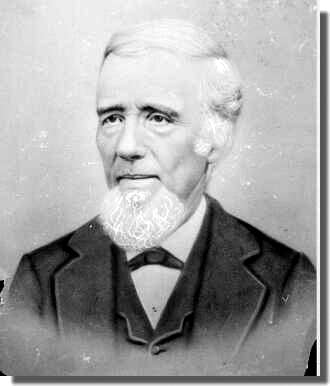
Roelof Sleyster (1815-1882)
Thomas > Thomas >
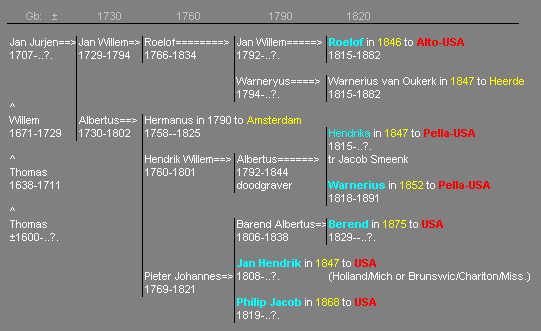
Willem > Jan Jurjen > Jan Willem > Roelof > Jan Willem > Roelof
|
Emigrant naar Alto USA The history of the emigration of the "Afgescheidenen" ("separated') we can find it being interwoven in the historical novel "Landverhuizers" (movers into another land/emigrants) by P.J.Risseeuw. In that book some letters of emigrants are recorded, for example a letter of Roelof Sleijster dated 25 august 1846. Several reprints appeared of this book. It describes the track to three places in America: Wisconsin, Grand Rapids en Pella.
Roelof
(1766-1835)
On 4 mei 1846 Roelof Sleijster departed from Velp, Arnhem to America, with the purpose of Wisconsin. That was just before the end of his study. He was a student of the separated ("afgescheiden") preachers Brummelkamp and Van Raalte. He was an important pioneer and passed information on to The Netherlands. On 25 august 1846 he wrote a letter to Ref. Brummelkamp. See "Landverhuizers". On 24 September 1846 Ref. Van Raalte departed from Holland with a group, also with the purpose of Wisconsin, but his choice was not made yet. At his arrival in America he did choose by the advice of American friends for Grand Rapids, where he had to survive many troubles and where many died that winter.
Johanna
Liesveld
(1822-1913) On the 'shiplist'
are standing the names of Jansje and Dientje Liesveld, 24 and 22 years old. On 4 June 1847 the ship arrived in New York and a year later, on 26 July 1847 Roelof and Johanna married in Milwaukee/Wisconsin and settled in Alto / Wisconsin.
Arend Sleyster
Johanna Sleyster
In this book "Landverhuizers" are many aspects of the life of Roelof Sleijster and Johanna Liesveld in order. The writer, P.J. Risseeuw, after careful investigation did process much historical data in this book, such as:
Quotations
On the first day of June 1846 we left our home at Dinxperloo, province of Gelderland, for Rotterdam; by way of Arnhem and the Rhine. At Rotterdam we took passage on the sailing vessel De Hollander. There were 100 passengers on board, of whom one-half were Hollanders; the others were Germans. Of the ten families of Hollanders seven came from Aalten, Varseveld, and Dinxperloo, from what is known as De Achterhoek. The others came from Velp near Arnhem and from the province of Zeeland. Of the many Hollanders on board the ship I had only been intimately acquainted with Rademaker and family, from Varseveld. He was one of the elders of the Reformed [Afgescheiden] Church of Varseveld, a gifted and devout Christian. Of this church I had been a catechumen till I left for America, and of which I still retain many blessed memories. On board the ship everything was about as inconvenient and as untidy or dirty as it could be. We were herded together almost like cattle. We had to provide our own provisions for the voyage. There was little chance for cooking. The stove, or range, or whatever you might call it, had only two or three holes, where the many families could do their cooking. The water for drinking and cooking was nasty. I yet imagine that I can smell it. Those who did attempt cooking on the stove were not always particular about the fire. At one time through someone's carelessness the ship took fire, and but for its timely discovery might have turned out very serious. We had only one severe storm that was considered really dangerous. When we left the ship there was one more passenger than when we boarded it. After being forty days on the Atlantic Ocean we landed at Boston. Our
aim, and that of the seven families mentioned above, was to reach Milwaukee, Wisconsin. But how
to get there was a serious question. There we were, strangers in a strange land; we understood
nobody, and nobody understood us. I could speak a little German, and so could Roelof Sleijster one of our fellow passengers. Well, as
best we could we made a bargain with a German agent to get us to Milwaukee. Through our
ignorance we knew nothing of the route we were to travel. This was in 1846, hence we were among
the very first that left old Holland to open the way to the West.
Then an article about the settlement and some personal circumstances written by Elton J. Bruins:The Dutch-immigrant Congregations of Alto, Wisconsin 1845-1900.
The journey
A greater encouragement came from Roelof Sleijster, who had arrived in 1846. He had been a student preparing for the ministry in the Seceder Church of Antonie Brummelkamp in Arnhem when he decided to join the mass migration to America. On August 26, 1846, he wrote to his mentor, Dominie Brummelkamp and praised the Alto area as a place to settle. Brummelkamp decided to publish Sleijster's letter, along with others, including one from Van Raalte, in a pamphlet entitled Stemmen Uit Noord-Amerika, met Begeleidend Woord van A. BrummeIkamp (Voices from North America with a Foreword by A. Brummelkamp.) Brummelkamp favored the emigration of many Seceders to America, and for Brummelkamp there was evidence in these letters that the move to America had the blessing of God. Brummelkamp had this to say of Sleijster: This brother wrote us many letters both from there [Milwaukee] and from Boston and other stopping places on his journey, pretty regularly one every three weeks, and we have not discovered any one of his letters to have been lost. He sent us many important messages. Although it pained us that he could not prosper in his studies, especially since we would very much like to have kept him as a preacher of the Gospel in the Fatherland, in the interest of those who must emigrate to America, his journeying ahead and sojourn there and activities and investigation will have great value. The Lord be with him and bless him further in this weighty work for the good of many sighing, worried, and faint hearts. If it be God's will, he will be able to become a preacher of the Gospel there. In his letter to Brummelkamp, Sleijster had also written for permission to preach.Alto
The first families who settled Alto organized congregational life
immediately. David A. Van Eck opened his home for services until a log church was constructed on
his property in 1847. The site of the first church was one-half mile from the center of the
present Alto village and the Alto Reformed Church. There is no record that Roelof Sleijster conducted the services, but since he had
the blessing of Brummelkamp to preach, it is certain that he gave some pastoral leadership to
the Alto congregation. G. Ter Beest, M. Duven, and Cornelius Veernhout provided the catechetical
instruction. The new congregation was pleased when Gerrit Baay accepted the call to be its
minister. Baay, a student and disciple of Hendrik P. SchoIte, arrived in Alto with his family in
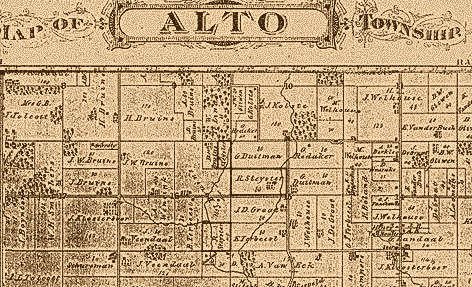
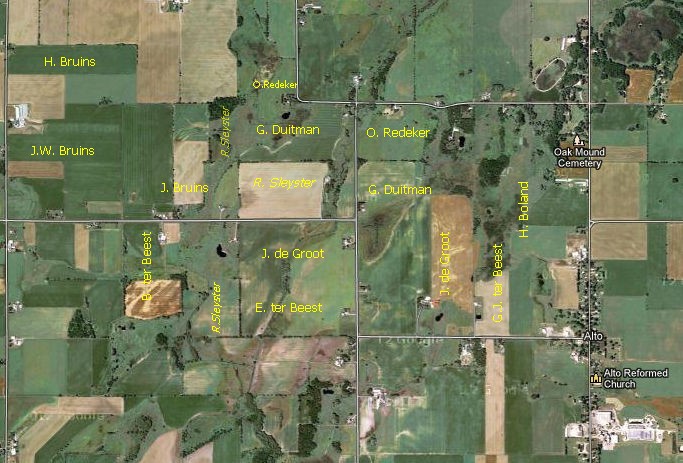
June of 1848. There is no indication that Roelof Sleijster leaded the worshipservices, but because he had the blessing of Brummelkamp to preach, it is sure that he gave some pastoral leadership to the community of Alto. G. ter Beest, M. Duven en Cornelis Veernhout took care of the catechetical teaching. The new community was glad that Gerrit Baay accepted the call to be her pastor. Baay, a student and follower of Hendrik P. Scholte, came with his family in Alto in June 1848. Note of Bruins: Although Sleijster was a prominent person in the Alto-community, there is no information about his life in Wisconsin. The familyname has become extinct. The Sleijster-farm was placed about one and a half mile west of the Alto-village. Note of Lucas ("Nederlanders in Amerika", p 167): Sleijster visited the Van Raalte-settlement in Michigan but he became so discouraged by the woods and the swamps in the Black River area, that he decided to return to Wisconsin.
|

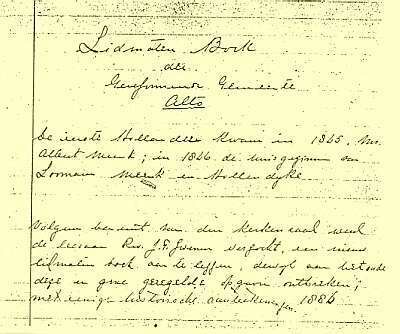
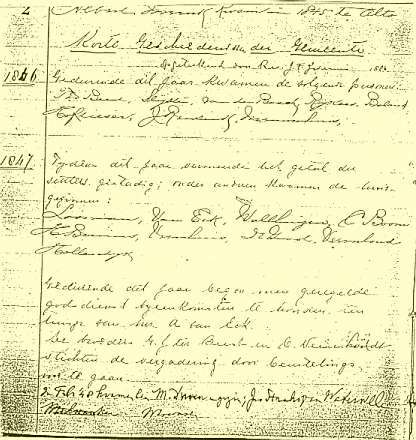
The first two pages of the Member book (Lidmatenboek)
of the Gereformeerde gemeente in Alto: in 1846: ...Sleyster...
|
|
Translation:
1847 - During this year increased
the number of the settlers continual: |
|
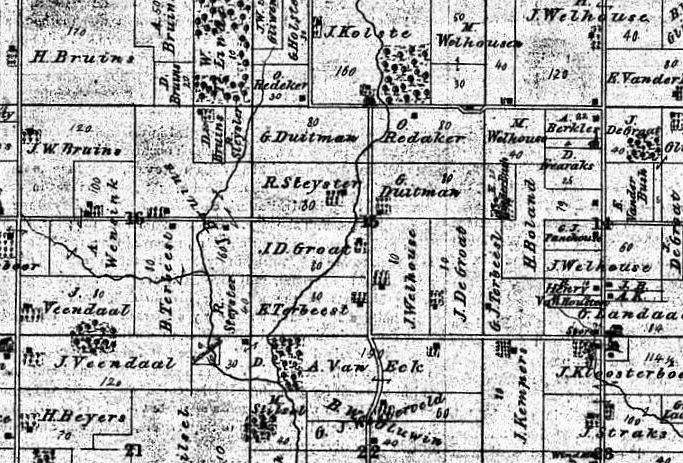
---- 1846-1870 ---- Ds. John H. Karsten/1897/about Alto: ... men like Van Raalte and Scholte served like stars to lead the people that had to follow. It is sure that religious views had somethings to do with determining their choice... In Wisconsin the Dutch did not settle in the same way as in Michigan or Iowa. The pioneers had no leaders. Individualisme characterised the movement... A number of Dutchmen occupied high and influential positions in the State.... The next have occupied positions of public confidence... ...Roelof Sleyster, member of the Assembly, 1870 ... Alto, situated in a municipality of the same name in the south west of Fond du Lac County, 6 miles west of Waupun, 68 miles from Milwaukee, on the Chigaco-Milwaukee-St.Paul-Railroad, was founded in 1846 by the Dutch, espespecially from the provence Gelderland. The first Dutch pioneers of Alto ware Albert Meenk en Nelson Hollerdyk, who came in 1845. The area around Alto excist mostly in open places and woods in the east part of the settlement, but the western part is a fertile prairie having a great produce. Not having much knoledge of the ground of the State, the Dutch pioneers fumbled haphazardly in this beautiful place. At first Alto was, before the railway came, extraordinarily isolated. But their church relations saved the kolonists from a stick isolation. They formed already soon a community of the Reformed Church in Amerika under the leadership of ds. Gerrit Baay from Apeldoorn. His small loghouse availed him and his family as a place of residence and the Dutch community as a house of worship, and as a school. In was inside of that loghouse that the religiouse life of the colonists recieved her first direction. First influences never die. Alto still feels the effects of that divine and devoted man, who was taken up from earth into heaven just too early. He worked only one and a half year under his followers in Alto. We believethat this solid standpoint for teaching and necessary god-fearing saved this community of the strangling materialisme. The Reformd Church has always been the biggest churchorganisation, although in the course of time there came a Dutch Presbyterian an a Christian Reformd Church .... The whole community of Alto is with some acceptions settled by Dutchmen. A few Dutch families have settled in the cities Waupun and Metomen. Public religious services are all found innthe Dutch language, although the people are fully americanized in everything, accept in the use of the English language. But the younger generation speaks English in everyday life.
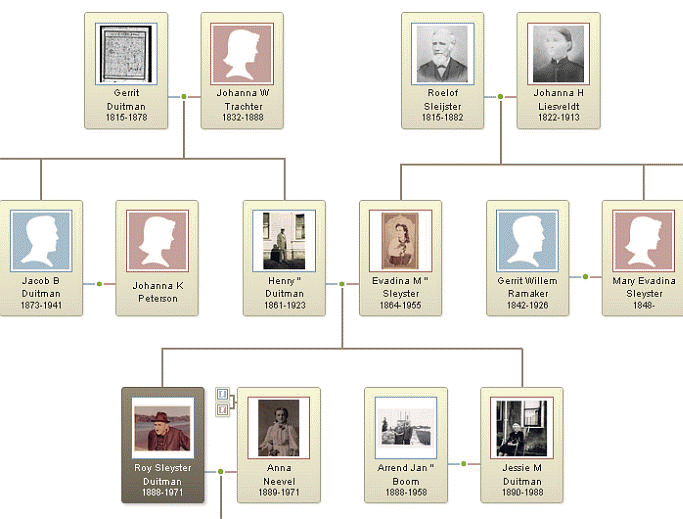
---- 1881 ---- 20-1-1881 Extract from the will of Roelof Sleyster from the city of Alto: First ... to my wife Johanna H. Sleyster all my Personal Property ... Second ... to Daughter Mary E. Ramaken, wife of G. Ramaken, to my son W.W. Sleyster, to my daughter Johanna H. Stelsel, wife of G.S. Stelsel, to my son Avon L. Sleyster, to my son Ralph H. Sleyster, to my daughter Coba R. Sleyster, to my son Henry J. Sleyster, to my daughter Evie H. Sleyster, to my son Benjamin U. Sleyster to be equally divided between them and their heirs share... The spread of the Sleijster emigrants
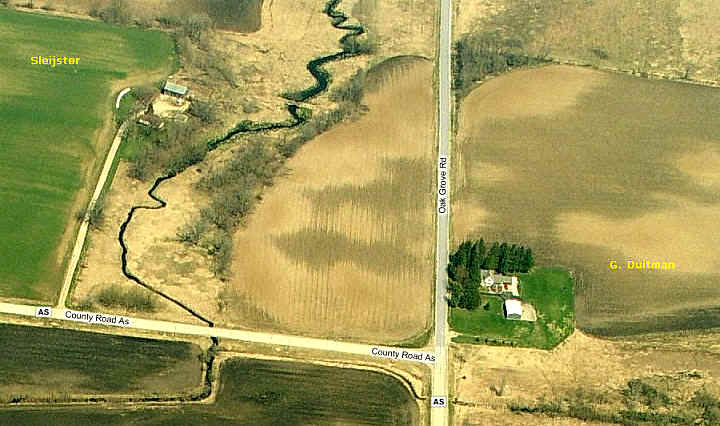
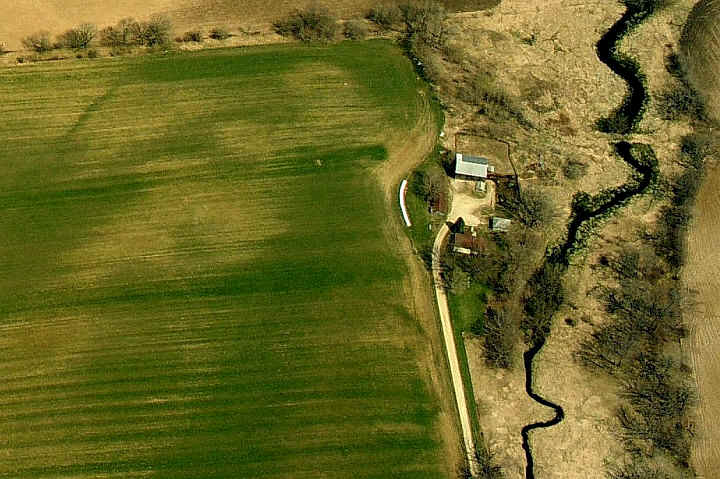
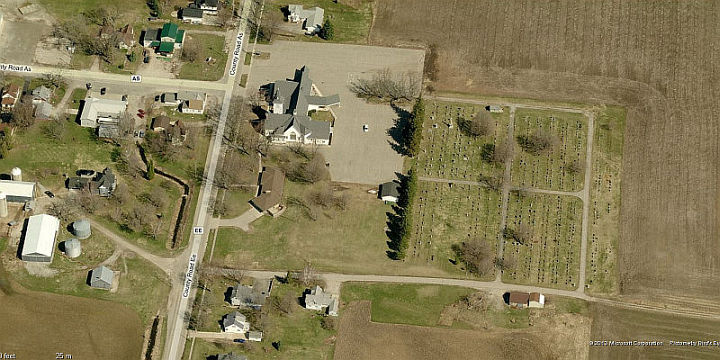
Some pictures from Bing-maps in 'birdview'
|
Roelof | Shadowbox-1 | Shadowbox-2 | Alto | Landverhuizers | Aaron | Letter Jacoba | Interview Jacoba | Overview pdf